Why Thailand Remains One of Southeast Asia's Most Competitive FX Markets

Updated: Jul 18
MARKET WATCH
Thailand Looks Easy. Until You Actually Enter It.
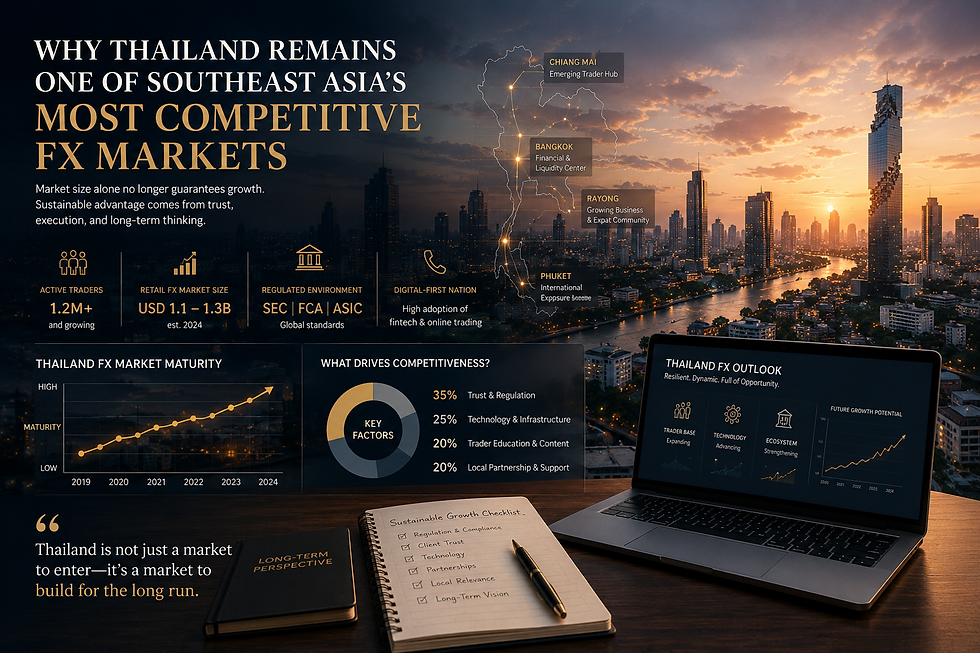
"Market size creates opportunity. Market maturity determines execution."
For many international brokers, Thailand appears to be an obvious opportunity.
A large retail trading community.
Strong participation in global financial markets.
An active introducing broker (IB) ecosystem.
High engagement across digital platforms.
On paper, the expansion plan looks straightforward.
Launch MT5.
Offer competitive spreads.
Build an attractive rebate program.
Hire a local team.
Growth should follow.
Yet for many firms, it doesn't.
Months pass.
Client acquisition slows.
IB recruitment becomes increasingly difficult.
Marketing costs rise.
Expectations fail to match reality.
The question is no longer whether Thailand is an attractive market.
The real question is why so many brokers struggle to grow in one of Southeast Asia's most active trading communities.
Thailand Is Large—But It Is No Longer a Greenfield Market
Thailand remains one of Southeast Asia's largest retail trading markets.
That part is widely understood.
What is often overlooked is that market size alone no longer creates competitive advantage.
The market has matured.
Relationships already exist.
Communities have already formed.
Trust has already been earned.
For new entrants, this fundamentally changes the challenge.
Success is no longer about introducing online trading.
It is about persuading experienced traders to change established behavior.
Those are entirely different strategic problems.
"Market size attracts attention. Market maturity determines who survives."
Thai investors have participated in financial markets for decades.
From equities and gold to futures, forex, CFDs, and digital assets, participation has continuously evolved.
Today, education is rarely the missing piece.
Differentiation is.
The Real Competitor Is Existing Trust
One of the most common assumptions among new entrants is that better products automatically win.
They rarely do.
Not because product quality is unimportant.
But because products are rarely evaluated in isolation.
In Thailand, trading decisions are filtered through relationships.
Recommendations.
Communities.
Years of accumulated experience.
Existing credibility.
Trust influences almost every buying decision.
Many traders remain with their existing broker not because it offers the lowest spread,
but because:
Their introducing broker recommended it.
Their mentor trades there.
Withdrawals have consistently been reliable.
Customer support has proven dependable.
The relationship has already earned their confidence.
A broker may offer superior pricing.
Better technology.
Better execution.
Yet still struggle to attract clients.
Because trust already belongs to someone else.
"Products attract attention. Trust earns deposits."
Competition Is No Longer About Products
Thailand is often described as a competitive market because many global brokers operate here.
That observation is only partially correct.
The real competition is not product versus product.
It is trust versus trust.
Across different trader segments, familiarity has already been established.
Some traders began their journey with one global broker.
Others built their experience elsewhere.
Many have spent years inside trading communities led by educators, IBs, and local partners.
Every established broker carries years of accumulated credibility.
New entrants are rarely starting from zero.
More often, they are starting behind someone else's reputation.
Why Some Brokers Stay for Years—And Still Don't Grow
Longevity is often mistaken for success.
It isn't.
Some brokers remain in Thailand for years without ever becoming market leaders.
Several patterns appear repeatedly.
Limited Local Commitment
Markets rarely become local simply because management remains global.
Thailand continues to be a relationship-driven market.
Without consistent local investment, growth eventually slows.
Weak Partnership Strategy
Many firms focus primarily on direct acquisition.
Meanwhile, successful competitors continuously invest in IBs, educators, communities, and long-term strategic partnerships.
No Clear Market Position
If traders cannot clearly explain why a broker is different, sustainable growth becomes increasingly difficult.
Being another broker is not a positioning strategy.
Poor Retention
Acquiring clients is expensive.
Losing them is even more expensive.
Many firms invest aggressively in acquisition while underinvesting in long-term engagement.
"Acquisition creates momentum. Retention creates enterprise value."
What Winning Brokers Do Differently
The fastest-growing brokers rarely succeed because of a single campaign.
They build systems that compound over time.
They Invest Before Results Appear
Markets are built before they are monetized.
The strongest firms understand that reputation requires patience.
They Build Relationships, Not Campaigns
Strong introducing brokers.
Trusted educators.
Active communities.
Growth accelerates when trust already exists before the first marketing campaign begins.
"Relationships shorten the sales cycle more effectively than advertising."
They Localize Operations
Winning brokers adapt to local expectations.
Thai-speaking support.
Reliable local payment infrastructure.
Fast withdrawals.
Market-specific communication.
Small operational details often create significant competitive advantages.
They Prioritize Retention
Successful brokers understand a simple economic reality.
A trader who remains active for three years often generates greater enterprise value than several traders who leave after only a few months.
Retention is not a customer support function.
It is a long-term growth strategy.
Strategic Implication
For executives considering Thailand, the strategic question is no longer:
"How do we launch?"
The more important question is:
"Why would experienced traders switch?"
Those are fundamentally different questions.
The first focuses on products.
The second focuses on trust.
Companies that confuse the two often underestimate the investment, local commitment, and consistency required to succeed.
Thailand rarely rewards speed alone.
It rewards credibility built over time.
The TVB Perspective
A strategic editorial viewpoint from The Verified Broker.
Thailand continues to be one of Southeast Asia's most attractive FX markets.
It is also becoming one of its most mature.
Market size explains demand.
It does not explain growth.
Growth increasingly depends on trust, execution, local partnerships, and long-term credibility.
Over the coming years, competitive advantage is likely to shift further away from acquisition alone and toward sustainable relationships.
The firms that succeed will not necessarily be those with the largest marketing budgets or the most aggressive promotions.
They will be the firms that understand one simple principle:
"In mature markets, trust becomes the product."
And in Thailand, trust is rarely bought. It is earned.


