The Biggest Mistake New Brokers Make in Thailand

Updated: Jul 18
MARKET WATCH
Why Sustainable Growth Rarely Begins With Acquisition Alone

For many international brokers, entering Thailand appears relatively straightforward.
The market is active.
Retail participation is well established.
Digital acquisition channels are widely available.
As a result, expansion strategies often begin with familiar priorities.
Advertising.
Bonuses.
Rebate programs.
Client acquisition.
These investments are not inherently misplaced.
The more important question is whether they are sufficient to support sustainable growth.
"Growth often begins with acquisition. Sustainable growth begins with retention."
In practice, many organisations discover that market expansion begins to slow long before acquisition budgets are exhausted.
The underlying challenge is rarely visibility.
More often, it is the absence of a strategy that extends beyond client acquisition itself.
Visibility Does Not Create Trust
Generating awareness is an essential stage of market expansion.
Advertising introduces a brand.
Content increases visibility.
Campaigns generate traffic.
Without awareness, growth rarely begins.
Yet awareness and trust are fundamentally different assets.
"Visibility earns attention. Execution earns trust."
Recognition may attract attention.
Credibility influences commitment.
In increasingly competitive markets, trust—not visibility—becomes the asset that compounds over time.
Short-Term Incentives Rarely Build Long-Term Loyalty
Promotional incentives continue to play an important role across the retail trading industry.
Bonuses reduce barriers for new clients.
Campaigns stimulate short-term activity.
Rebate programs improve acquisition efficiency.
However, incentives also influence the composition of the client base.
Markets competing primarily through promotional offers often experience higher client mobility, shorter retention cycles, and lower long-term engagement.
As promotional activity increases, acquisition may accelerate while relationship quality gradually declines.
The strategic question therefore changes.
The objective is no longer simply acquiring more clients.
It becomes retaining the right ones.
"Acquisition creates customers. Retention creates businesses."
Competing on Price Is Increasingly Difficult
Pricing remains one of the industry's most common competitive tools.
Lower spreads.
Higher rebates.
More attractive promotions.
All remain effective.
They are also among the easiest advantages for competitors to replicate.
Over time, differentiation based primarily on financial incentives becomes increasingly difficult to sustain.
The firms that continue to grow are often those competing beyond price.
They invest in trusted partnerships.
Operational consistency.
Industry relationships.
Community engagement.
Long-term credibility.
These advantages require considerably more time to build.
They are also significantly more difficult to copy.
"Price can be copied. Capability cannot."
Retention Is Often the Most Undervalued Growth Strategy
One of the most overlooked assets inside many organisations is their existing client base.
Considerable resources are allocated to acquiring new relationships, while comparatively little attention is given to maintaining existing ones.
Inactive clients remain inactive.
Introducing Brokers gradually disengage.
Relationships weaken through lack of communication rather than competitive pressure.
Growth often slows incrementally before the decline becomes visible in management reporting.
By the time acquisition costs begin to rise, retention opportunities have frequently already been lost.
Retention is therefore not simply a customer support function.
It is a strategic growth capability.
"Retention is not an operational function. It is a competitive advantage."
Markets Are Built Through Operating Capability
Another pattern appears consistently across expanding organisations.
Commercial expectations frequently exceed operational investment.
Local leadership is expected to deliver growth.
Regional marketing manages multiple markets simultaneously.
Partner engagement receives limited resources.
Decision-making remains centralised.
Execution slows accordingly.
"Markets rarely fail because they lack demand. They fail because organisations underestimate execution."
People execute strategy.
Organisations determine whether execution is possible.
Sustainable Growth Rarely Depends on Individuals
Expansion strategies often place considerable emphasis on recruiting exceptional talent.
The ideal Country Manager.
The ideal Business Development Manager.
The ideal commercial leader.
In reality, sustainable organisations are rarely built around exceptional individuals alone.
They are built around operating environments that allow capable people to perform consistently.
Clear strategic direction.
Organisational trust.
Appropriate resources.
Local decision-making.
Shared accountability.
These factors frequently explain performance more accurately than recruitment alone.
Markets scale through teams rather than individuals.
"Successful market development rarely depends on exceptional people alone. It depends on organisations that enable exceptional execution."
TVB Perspective
A strategic editorial viewpoint from The Verified Broker.
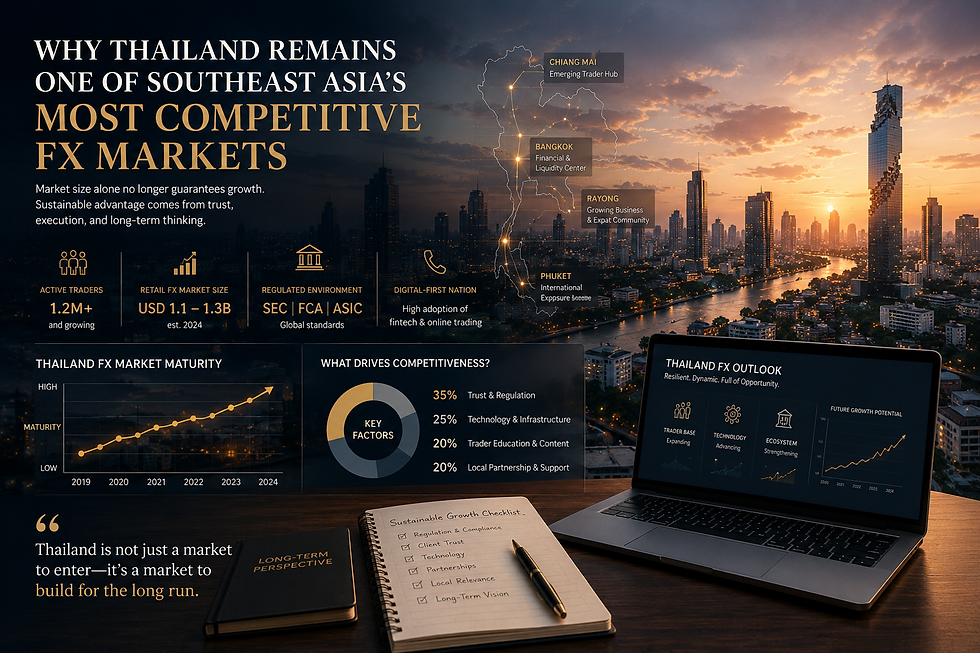
Thailand remains one of Southeast Asia's most established retail trading markets.
It is also becoming one of its most competitive.
As markets mature, acquisition alone becomes a less reliable source of sustainable growth.
Competitive advantage increasingly shifts toward operational capability, client retention, trusted partnerships, local leadership, and disciplined execution.
"Competitive advantage rarely comes from what is easiest to copy. It comes from what competitors struggle to replicate."
The strategic question is therefore no longer how quickly a broker can acquire clients.
It is whether the organisation can continue earning their trust long after the first deposit.